
Some digital businesses sell “by magic.” And then there are those that sell because they have a system. Guess which ones sleep better.
An effective sales funnel is that nervous system that turns strangers into customers, and customers into ambassadors. Done right, it's not “one page and done.” It's an architecture that is tested, measured and optimized like a product. And when you do it well, the improvements show: documented conversion increases of 15% to 25% y 5%–15% extra revenue by recovering opportunities that were already “almost there” (for example, abandoned carts).
Let's get to it.
1) What a sales funnel is and why yours “isn't broken,” just incomplete
A funnel organizes the customer journey in stages. The modern version understands something key: the sale isn't the end, it's the start of the most profitable stage. That's why you'll increasingly see the “flywheel” approach: you optimize for lifetime value, not for an isolated transaction.
Quick definition:
- Funnel: guides a user from “I don't know you” to “take my money.”
- Flywheel: turns that purchase into repeat business, referrals and growth with less dependence on ads.
Typical (and costly) mistakes: a fuzzy target audience, no goals per stage, generic copy and trying to sell before building trust.
2) The stages that work in a sales funnel in 2026: ToFu, MoFu, BoFu and loyalty
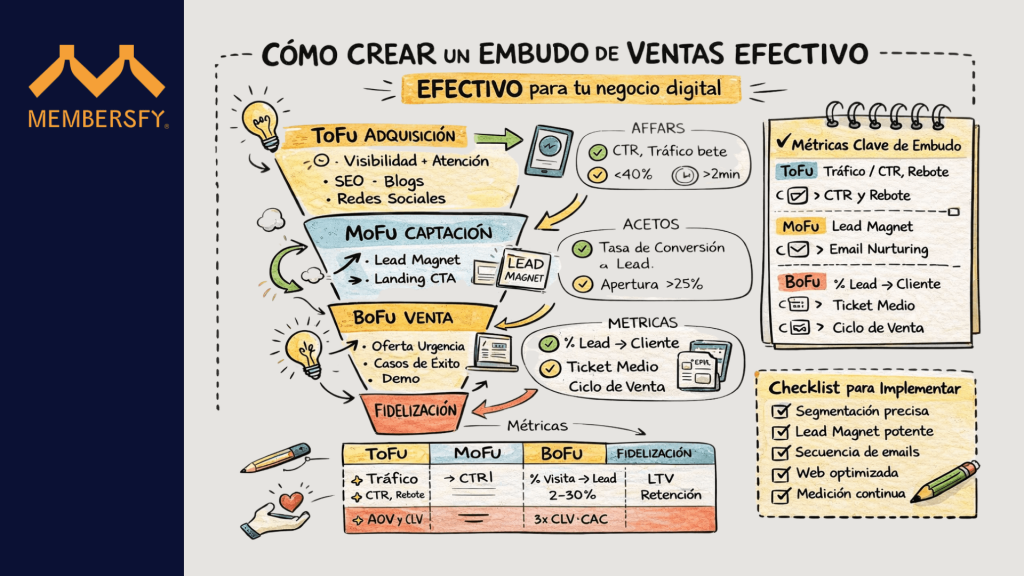
A practical funnel for a digital business usually has 4 stages: Acquisition (ToFu), Capture (MoFu), Sale (BoFu) and Loyalty. And each stage has different goals, assets and metrics.
A figure to ground your expectations
A typical progression example (so you don't fool yourself with “lots of visits”): from 10.000 visitors, ~2.000 leads (20%), 800 MQLs (40% of leads), 240 opportunities (30% of MQLs) y 48 customers (20% of SQLs).
Can it be improved? Yes. Is it improved with “motivation”? No. It's improved with assets, messages and measurement.
3) Design your sales funnel starting with what nobody wants to do: segmentation and offer
If you attract “everyone,” you convert “almost no one.” Precise segmentation is the foundation: demographic, behavioral, psychographic and intent.
Practical process (15 minutes, no poetry):
- Define 1 main buyer persona (pain, desire, objections, context).
- Write your promise as a concrete transformation (result + timeframe + condition).
- List the 3 most frequent objections (price, time, “I already tried”).
- Decide your ideal “next step”: lead? demo? direct sale?
Simple example:
“Email marketing course” is vague.
“An email system that generates sales without depending on posting every day” has teeth.
Common mistake: generic promises like “increase your sales.” That's not copy, it's noise.
4) Build ToFu (Acquisition): attract traffic with intent, not with fireworks
In ToFu the goal is visibility + attention. This is where SEO, educational content, social and paid campaigns win.
Typical tactics: Digital PR, SEO, social media and influencer marketing.
Assets that convert in ToFu:
- Articles that tackle specific problems (guides, comparisons, “how-tos”).
- Videos and webinars to educate quickly.
ToFu metrics that really matter:
- Traffic by channel, bounce rate, time on site, pages per session.
(Useful reference: bounce rate <40% usually indicates relevance, and >2 min suggests engagement).
Common mistake: measuring ToFu only by visits. Visits without intent are like applause at a funeral: lots of noise, little use.
5) Set up MoFu (Capture): your lead magnet and your nurturing do the heavy lifting
MoFu turns visitors into qualified leads by delivering value in exchange for contact details. The heart of it is lead nurturing, which can boost SQL generation by up to 50% at a lower cost when it's well designed.
What you must build:
- Lead magnet with immediate value (checklist, template, mini-course, quick audit).
- Landing page with a clear offer, social proof and a frictionless form.
- Welcome sequence + nurturing (educate, resolve objections, guide to the next action).
A powerful stat to convince your skeptical self: in 2024 it was documented that email automations generated 37% of sales with just 2% of email volume, and the purchase rate was 1 in 3 clicks vs 1 in 18 in scheduled campaigns.
MoFu metrics:
- Lead conversion (ballpark benchmarks: 2–5% cold traffic, 20–40% warm traffic).
- MQLs generated.
- Email open rate >25% and CTR >3% as a practical reference.
Common mistake: “I'll send 10 emails and that's it.” No. Nurturing is a conversation. If it sounds like a megaphone, the user leaves.
6) Optimize BoFu (Sale): offer, social proof, urgency and zero friction
In BoFu the user is close to deciding. Here limited offers, demos, success stories and customer success resources work.
Levers that move the needle most:
- Urgency and scarcity used well.
- Social proof (reviews, cases, numbers).
- Guarantee to reduce perceived risk.
Ecommerce tip: coordinated campaigns email + SMS + retargeting consistently recover 10%–30% of abandoned carts.
BoFu metrics:
- Customer conversion (ballpark reference: 2–5% of total traffic o 20–30% of SQLs).
- Average order value (AOV).
- Sales cycle length.
- ROAS.
Common mistake: “my product is expensive” when the real problem is “my offer is poorly explained.”
7) Loyalty in a sales funnel: where the margin is and where almost nobody puts any love
If your funnel ends at the sale, you're throwing money away with worrying elegance. The post-purchase phase measures and multiplies value.
What to implement:
- Onboarding (get to the “aha moment” fast in SaaS).
- Upsell and cross-sell that make sense.
- Community or referral program when it fits.
Key metrics:
- CLV/LTV, retention/churn, NPS, Net Revenue Retention.
- Economic health: CAC <33% of CLV, ratio CLV:CAC >3:1, ROAS >3:1 as a common reference.
8) Metrics table by stage (so you don't live on intuition)
| Stage | Goal | Key metrics |
|---|---|---|
| Acquisition (ToFu) | Visibility + attention | CTR, traffic by channel, bounce rate, time on page, visit quality |
| Capture (MoFu) | Convert to lead + qualify | % visit→lead, MQL/SQL, % qualified leads, CPL, email engagement |
| Sale (BoFu) | Closing + profitability | % lead→sale, AOV/order value, CAC by channel, ROAS, sales cycle |
| Loyalty | Retain + expand | LTV/CLV, retention, recurrence, frequency, referrals |
9) Implementation checklist for an effective sales funnel (MVP in 4 phases)
Phase 1. Strategy (week 1–2):
- Buyer persona defined.
- Customer journey mapped.
- SMART goals per stage.
- Tech stack chosen.
Phase 2. Assets (week 3–6):
- Lead magnet + landing page.
- Email sequence (welcome, nurturing, reactivation, carts).
- Automations and tracking.
Phase 3. Launch and testing (week 7–10):
- MVP with controlled traffic.
- Events, pixels, UTMs.
- First campaigns.
Phase 4. Continuous optimization:
- Weekly review.
- Systematic A/B testing.
- Scale what works, pause what doesn't.
10) Recommended tools (without going crazy with 17 tabs)
A reasonable stack usually includes automation + analytics + CRO:
- Automation/CRM
- Analytics
- CRO and behavior
You know the best part? With Membersfy you have it all in one.
Common mistake: buying tools to make up for a weak strategy. Tools amplify. They don't fix.
Risks and when NOT to apply this approach as is
- If your product doesn't have “product-market fit” yet, a funnel will only speed up traffic toward a bad experience.
- If you can't deliver value post-purchase, you'll grow fast… and leave just as fast (hello, churn).
- If your margin can't support ads, prioritize SEO, community and referrals.
You might also want to read:
Automation in a digital business
The best of 2025 in digital businesses (and how to turn them into a source of revenue)
How to Design a Digital Course
FAQs about sales funnels (real questions from real people)
What's the difference between ToFu, MoFu and BoFu?
ToFu attracts and generates interest, MoFu captures the contact and qualifies with nurturing, BoFu converts with an offer and risk reduction. Measuring and optimizing the handoffs between stages is what drives results.
What's the most important funnel metric?
It depends on the bottleneck. If little traffic comes in, look at ToFu. If there's traffic but few leads, MoFu. If there are leads but no sales, BoFu. And if you sell but they don't come back, your queen metric is LTV/CLV.
What lead conversion rate is “normal”?
For reference, it can be 2–5% for cold traffic and 20–40% for warm traffic. What matters is comparing by channel and by intent, not lumping everything into a pretty average.
How do I know if my CAC is healthy?
A practical guide: CAC should be less than 33% of CLV and the ratio CLV:CAC should be >3:1 for a healthy model.
How many emails does a nurturing sequence need?
Enough to move the person to a decision without overloading them. Start with 5–7 (welcome + value + objections + case + CTA) and optimize by engagement. Well-built automations can account for a large share of sales with little volume.
What do I do if I get lots of visits but don't sell?
Check, in this order: (1) traffic intent, (2) offer and message, (3) friction on the landing page/checkout, (4) social proof, (5) follow-up and nurturing. Also make sure you measure where the flow breaks; without that you're optimizing blind.
If you want us to review your sales funnel and tell you where money is leaking, get your basic metrics ready (traffic, leads, sales) and book an audit.
If you don't want to miss articles as powerful as this one, follow us on Linkedin o Instagram
Launch your own
academy today
Stop depending on social media algorithms. Build a real, scalable business that is 100% yours.